VR system. More...
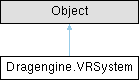
Static Public Member Functions | |
Management | |
| static bool | runtimeUsable () |
| VR Runtime is usable. | |
| static void | requestFeatureEyeGazeTracking (VRFeatureSupportLevel level) |
| Set feature request level for eye gaze tracking. | |
| static void | requestFeatureFacialTracking (VRFeatureSupportLevel level) |
| Set feature request level for facial tracking. | |
| static void | requestFeatureBodyTracking (VRFeatureSupportLevel level) |
| Set feature request level for body tracking. | |
| static bool | supportsEyeGazeTracking () |
| Eye gaze tracking is supported. | |
| static bool | supportsFacialTracking () |
| Facial tracking is supported. | |
| static bool | supportsBodyTracking () |
| Body tracking is supported. | |
| static void | startRuntime () |
| Start VR. | |
| static void | stopRuntime () |
| Stop VR. | |
| static bool | isRuntimeRunning () |
| VR is running. | |
| static Camera | getCamera () |
| Camera to render on head mounted display or null. | |
| static void | setCamera (Camera camera) |
| Set camera to render on head mounted display. | |
| static bool | supportsPassthrough () |
| VR Runtime supports presenting user environment inside the rendered world. | |
| static bool | getEnablePassthrough () |
| Presenting user environment inside the rendered world is enabled. | |
| static void | setEnablePassthrough (bool enable) |
| Enable presenting user environment inside the rendered world. | |
| static float | getPassthroughTransparency () |
| Transparency of user environment presented inside the rendered world. | |
| static void | setPassthroughTransparency (float transparency) |
| Set transparency of user environment presented inside the rendered world. | |
| static void | centerPlayspace () |
| Center playspace with forward direction matching looking direction. | |
Input devices | |
| static int | getDeviceCount () |
| Number of input devices. | |
| static InputDevice | getDeviceAt (int index) |
| Information for input device at index. | |
| static int | indexOfDeviceWithID (String id) |
| Index of device with identifier or -1 if absent. | |
| static int | indexOfButtonWithID (int device, String id) |
| Index of button with identifier on device at index or -1 if absent. | |
| static int | indexOfAxisWithID (int device, String id) |
| Index of axis with identifier on device at index or -1 if absent. | |
| static int | indexOfFeedbackWithID (int device, String id) |
| Index of feedback with identifier on device at index or -1 if absent. | |
| static bool | getButtonPressed (int device, int button) |
| Button at index on device at index is pressed down. | |
| static bool | getButtonTouched (int device, int button) |
| Button at index on device at index is touched. | |
| static bool | getButtonNear (int device, int button) |
| User finger is near button at index on device at index. | |
| static float | getAxisValue (int device, int axis) |
| Value of axis at index on device at index. | |
| static float | getFeedbackValue (int device, int feedback) |
| Value of feedback at index on device at index. | |
| static void | setFeedbackValue (int device, int feedback, float value) |
| Set value of feedback at index on device at index. | |
Parameters | |
| static int | getParameterCount () |
| Number of parameters available. | |
| static ModuleParameter | getParameterInfo (int index) |
| Parameter information. | |
| static ModuleParameter | getParameterInfo (String name) |
| Named parameter information or null if not found. | |
| static String | getParameterValue (String name) |
| Parameter value. | |
| static void | setParameterValue (String name, String value) |
| Set named parameter value. | |
| static String | sendCommand (String command) |
| Send command. | |
Detailed Description
VR system.
- Version
- 1.6
This is a native class. This is a pure static class. The class can not be instantiated
Member Function Documentation
◆ centerPlayspace()
|
static |
Center playspace with forward direction matching looking direction.
- Version
- 1.28
Has no effect if runtime is not running.
Playspace is not automatically centered after starting the VR runtime. Call this function any time later to center the playspace, for example if the player adjusted seating position or if the VR runtime uses a broken playspace orientation.
References getPassthroughTransparency().
Referenced by getButtonPressed().
◆ getAxisValue()
|
static |
◆ getButtonNear()
|
static |
User finger is near button at index on device at index.
- Version
- 1.28
References getDeviceCount().
Referenced by sendCommand().
◆ getButtonPressed()
|
static |
Button at index on device at index is pressed down.
References centerPlayspace().
Referenced by getParameterInfo().
◆ getButtonTouched()
|
static |
Button at index on device at index is touched.
Referenced by getParameterValue().
◆ getCamera()
|
static |
Camera to render on head mounted display or null.
Referenced by supportsPassthrough().
◆ getDeviceAt()
|
static |
Information for input device at index.
References setPassthroughTransparency().
Referenced by getAxisValue().
◆ getDeviceCount()
|
static |
Number of input devices.
Referenced by getButtonNear().
◆ getEnablePassthrough()
|
static |
Presenting user environment inside the rendered world is enabled.
- Version
- 1.12
Returns false if SupportsPassthrough() returns false.
References setCamera().
Referenced by getPassthroughTransparency().
◆ getFeedbackValue()
|
static |
Value of feedback at index on device at index.
Referenced by sendCommand().
◆ getParameterCount()
|
static |
◆ getParameterInfo() [1/2]
|
static |
Parameter information.
- Exceptions
-
EOutOfBoundary index less than 0 or greater than or equal to getParameterCount().
References indexOfFeedbackWithID().
Referenced by sendCommand().
◆ getParameterInfo() [2/2]
|
static |
Named parameter information or null if not found.
References getButtonPressed().
◆ getParameterValue()
|
static |
Parameter value.
- Exceptions
-
EInvalidParam Parameter with name not found.
References getButtonTouched().
Referenced by sendCommand().
◆ getPassthroughTransparency()
|
static |
Transparency of user environment presented inside the rendered world.
- Version
- 1.12
Has no effect if SupportsPassthrough() returns false. A value of 0 hides the environment. A value of 1 shows the environment. Values in between blend over.
References getEnablePassthrough().
Referenced by centerPlayspace().
◆ indexOfAxisWithID()
|
static |
Index of axis with identifier on device at index or -1 if absent.
Referenced by getParameterCount().
◆ indexOfButtonWithID()
|
static |
Index of button with identifier on device at index or -1 if absent.
Referenced by setFeedbackValue().
◆ indexOfDeviceWithID()
|
static |
Index of device with identifier or -1 if absent.
Referenced by setFeedbackValue().
◆ indexOfFeedbackWithID()
|
static |
Index of feedback with identifier on device at index or -1 if absent.
Referenced by getParameterInfo().
◆ isRuntimeRunning()
|
static |
VR is running.
- Version
- 1.8
VR systems typically are required to be activated before they can be used. Starting VR connects the engine to the VR system present on the host system and activates VR support on various modules. VR mode can be started and stopped at any time.
References stopRuntime().
Referenced by setCamera().
◆ requestFeatureBodyTracking()
|
static |
Set feature request level for body tracking.
- Version
- 1.31
Body tracking provides the pose of body as input device bones. Estimating bode pose is an expensive operation running on the headset. The majority of games and applications do not require body tracking. To enable set the feature request level to VRFeatureSupportLevel#optional or VRFeatureSupportLevel#required.
The set feature request level takes effect only the next time startRuntime() is called. It has no effect while the VR runtime is running.
If the VR module does not support body tracking and VRFeatureSupportLevel#required is specified an exception is thrown.
References requestFeatureBodyTracking().
Referenced by requestFeatureBodyTracking().
◆ requestFeatureEyeGazeTracking()
|
static |
Set feature request level for eye gaze tracking.
- Version
- 1.17
Tracking eye gaze features is consider a high privacy operation by most VR environments. Enabling this feature usually requires the user to explicitely agree. Furthermore eye gaze tracking is not required for the majority of games and applications. For these reasons eye gaze tracking is disabled by default. To enable set the feature request level to VRFeatureSupportLevel#optional or VRFeatureSupportLevel#required.
The set feature request level takes effect only the next time StartRuntime() is called. It has no effect while the VR runtime is running.
If the VR module does not support eye gaze tracking and VRFeatureSupportLevel#required is specified an exception is thrown.
References requestFeatureEyeGazeTracking().
Referenced by requestFeatureEyeGazeTracking().
◆ requestFeatureFacialTracking()
|
static |
Set feature request level for facial tracking.
- Version
- 1.17
Facial tracking includes eye tracking and mouth tracking. Tracking facial features is consider a high privacy operation by most VR environments. Enabling this feature usually requires the user to explicitely agree. Furthermore facial tracking typically is an expensive operation and can degrade performance. Last but not least facial tracking is not required for the majority of games and applications. For this reason facial tracking is disabled by default. To enable set the feature request level to VRFeatureSupportLevel#optional or VRFeatureSupportLevel#required.
The set feature request level takes effect only the next time StartRuntime() is called. It has no effect while the VR runtime is running.
If the VR module does not support facial tracking and VRFeatureSupportLevel#required is specified an exception is thrown.
References requestFeatureFacialTracking().
Referenced by requestFeatureFacialTracking().
◆ runtimeUsable()
|
static |
VR Runtime is usable.
Returns true if a call to startRuntime() is likely to succeed or not.
References runtimeUsable().
Referenced by runtimeUsable().
◆ sendCommand()
|
static |
Send command.
References getAxisValue(), getButtonNear(), getFeedbackValue(), getParameterCount(), getParameterInfo(), getParameterValue(), sendCommand(), setFeedbackValue(), and setParameterValue().
Referenced by sendCommand().
◆ setCamera()
|
static |
Set camera to render on head mounted display.
If set to null fades back to safe scene as defined by VR Runtime.
References isRuntimeRunning().
Referenced by getEnablePassthrough().
◆ setEnablePassthrough()
|
static |
Enable presenting user environment inside the rendered world.
- Version
- 1.12
Has no effect if SupportsPassthrough() returns false.
References supportsPassthrough().
Referenced by setPassthroughTransparency().
◆ setFeedbackValue()
|
static |
Set value of feedback at index on device at index.
References indexOfButtonWithID(), and indexOfDeviceWithID().
Referenced by sendCommand().
◆ setParameterValue()
|
static |
Set named parameter value.
- Exceptions
-
EInvalidParam Parameter with name not found.
Referenced by sendCommand().
◆ setPassthroughTransparency()
|
static |
Set transparency of user environment presented inside the rendered world.
- Version
- 1.12
Has no effect if SupportsPassthrough() returns false. A value of 0 hides the environment. A value of 1 shows the environment. Values in between blend over.
References setEnablePassthrough().
Referenced by getDeviceAt().
◆ startRuntime()
|
static |
Start VR.
VR systems typically are required to be activated before they can be used. Starting VR connects the engine to the VR system present on the host system and activates VR support on various modules. VR mode can be started and stopped at any time.
Referenced by stopRuntime().
◆ stopRuntime()
|
static |
Stop VR.
VR systems typically are required to be activated before they can be used. Starting VR connects the engine to the VR system present on the host system and activates VR support on various modules. VR mode can be started and stopped at any time.
References startRuntime().
Referenced by isRuntimeRunning().
◆ supportsBodyTracking()
|
static |
Body tracking is supported.
- Version
- 1.31
Can be called after startRuntime() returned successfully. Returns true if body tracking has been requested and is supported by the VR runtime.
References supportsBodyTracking().
Referenced by supportsBodyTracking().
◆ supportsEyeGazeTracking()
|
static |
Eye gaze tracking is supported.
- Version
- 1.31
Can be called after startRuntime() returned successfully. Returns true if eye gaze tracking has been requested and is supported by the VR runtime.
References supportsEyeGazeTracking().
Referenced by supportsEyeGazeTracking().
◆ supportsFacialTracking()
|
static |
Facial tracking is supported.
- Version
- 1.31
Can be called after startRuntime() returned successfully. Returns true if facial tracking has been requested and is supported by the VR runtime.
References supportsFacialTracking().
Referenced by supportsFacialTracking().
◆ supportsPassthrough()
|
static |
VR Runtime supports presenting user environment inside the rendered world.
- Version
- 1.12
References getCamera().
Referenced by setEnablePassthrough().
The documentation for this class was generated from the following file: